

Why the Right Industrial Spare Parts Manufacturer Matters
When a critical machine goes down on a production floor, every minute of downtime translates directly into lost revenue. Whether you operate in automotive, aerospace, pharmaceuticals, or food processing, the quality and reliability of your spare parts are non-negotiable. Choosing the right industrial spare parts manufacturer is not just a procurement decision — it’s a strategic investment that impacts your operational efficiency, product quality, and long-term profitability.
But with hundreds of manufacturers competing for your business, how do you identify the one that truly delivers? What separates a world-class supplier from a mediocre one? And what should modern industrial buyers look for in a manufacturing partner in 2024 and beyond?
This comprehensive guide breaks down everything you need to know — from evaluating manufacturing capabilities and quality standards to understanding precision technologies and industry-specific requirements. Whether you’re sourcing parts for the first time or looking to upgrade your current supplier, this article gives you the clarity to make an informed, confident decision.
What Is an Industrial Spare Parts Manufacturer?
An industrial spare parts manufacturer is a company that designs, fabricates, and supplies components used to maintain, repair, or replace worn or broken parts in industrial machinery and equipment. These parts can range from simple fasteners and gaskets to highly complex precision-machined components with tolerances measured in microns.
Unlike standard commodity suppliers, specialized manufacturers offer:
- Custom-engineered components tailored to specific machine models or operational requirements
- Precision manufacturing using CNC machining, die casting, injection molding, and other advanced techniques
- Material expertise across metals, polymers, composites, and alloys
- Quality assurance aligned with international standards like ISO 9001, IATF 16949, or AS9100
The distinction matters. A genuine industrial spare parts manufacturer doesn’t just replicate parts — they engineer solutions that enhance performance, extend machinery lifespan, and reduce total cost of ownership.
Key Industries That Rely on Industrial Spare Parts Manufacturers
An experienced industrial spare parts manufacturer typically serves multiple sectors, each with its own demanding set of specifications:
Automotive Industry
The automotive sector demands components with extreme dimensional accuracy, fatigue resistance, and heat tolerance. Stamping dies, metal brackets, bushings, and precision inserts are just a few examples of parts that must meet zero-defect standards.
Aerospace and Defense
Possibly the most stringent of all sectors, aerospace and defense require parts with full material traceability, tight tolerances, and compliance with international aviation standards. Any compromise in quality is simply not acceptable.
Pharmaceutical and Medical
Components used in pharmaceutical manufacturing equipment and medical devices must meet cleanroom standards and be manufactured from biocompatible, corrosion-resistant materials.
Food and Beverage Processing
Food-grade machinery demands parts made from materials that resist contamination, withstand rigorous cleaning cycles, and comply with food safety regulations.
Packaging
High-speed packaging machines rely on precision molds, cams, and mechanical assemblies. Any slight deviation in part quality can disrupt entire production lines.
Core Manufacturing Capabilities to Look For
When evaluating an industrial spare parts manufacturer, their production capabilities are your first filter. Here’s what a top-tier manufacturer should offer:
CNC Precision Machining
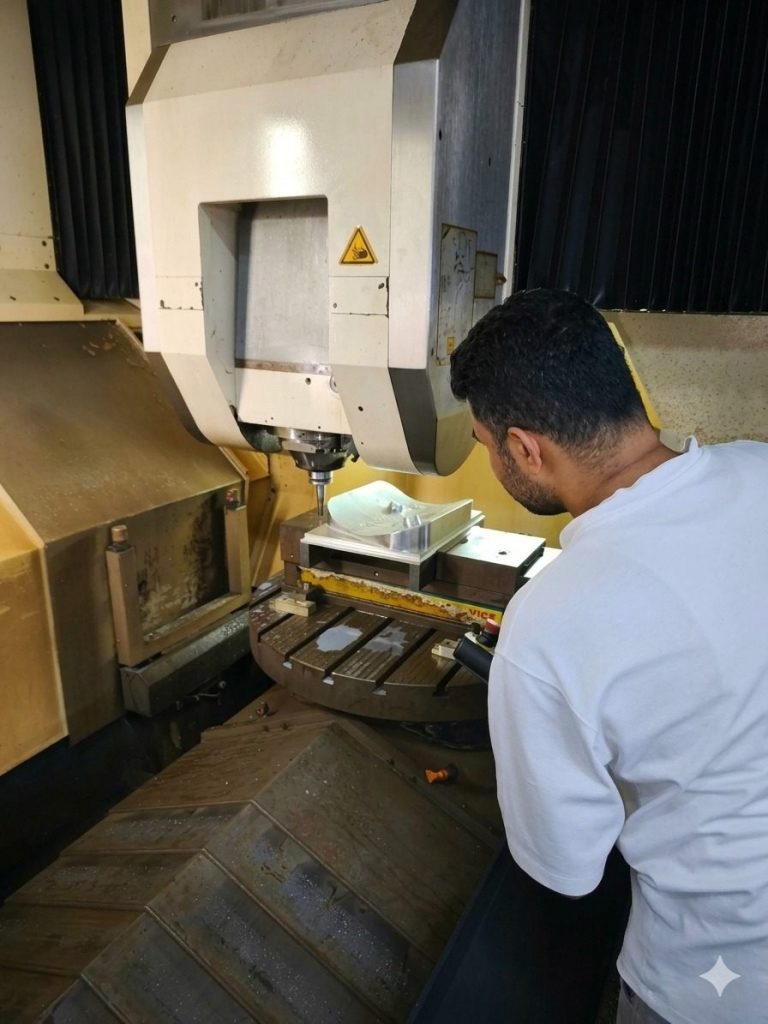
Computer Numerical Control (CNC) machining is the backbone of modern precision parts manufacturing. It enables consistent, repeatable production of complex geometries with tolerances as tight as ±0.001mm. Look for manufacturers who invest in multi-axis CNC centers and maintain regular calibration schedules.
Metal Stamping and Press Die Manufacturing
Stamping dies — including cutting, bending, and forming dies — are essential for high-volume production of sheet metal components. A capable manufacturer will handle [die design and fabrication] in-house, from concept to finished tooling.
Injection and Blow Molding
For plastic spare parts, injection molding and blow molding capabilities are critical. High-quality manufacturers maintain strict process controls to ensure dimensional consistency across large production runs.
Die Casting
Die casting enables the production of complex metal parts with excellent surface finish and dimensional accuracy. This is particularly valuable for components used in automotive and industrial machinery applications.
General Cutoff Parts and Assemblies
Beyond custom components, reputable industrial spare parts manufacturers also supply standard [general cutoff parts] and sub-assemblies that support a wide range of machine types and configurations.
Quality Standards and Certifications: What They Mean for You
[STAT] According to a McKinsey & Company report on industrial manufacturing, companies that implement rigorous supplier quality management programs reduce production downtime by up to 36% compared to those using unvetted suppliers.
Quality certifications are not just badges — they are documented proof of a manufacturer’s commitment to consistency and process control. When reviewing an industrial spare parts manufacturer, verify:
- ISO 9001:2015 — General quality management system standard
- IATF 16949 — Automotive-specific quality standard
- AS9100 — Aerospace and defense quality requirements
- ISO 13485 — Medical device quality management
Beyond certifications, ask about their in-house quality control labs, inspection equipment (CMMs, optical comparators, hardness testers), and statistical process control (SPC) practices.
The Role of Technology in Modern Spare Parts Manufacturing
[STAT] The global industrial spare parts market is projected to grow at a CAGR of 5.8% through 2030, driven by increasing automation, aging machinery infrastructure, and the rise of predictive maintenance strategies, according to Grand View Research.
Technology is transforming what it means to be a competitive industrial spare parts manufacturer today:
Advanced CNC Multi-Axis Machining
Modern 5-axis CNC machines allow manufacturers to produce intricate geometries in a single setup, reducing lead times and improving accuracy.
CAD/CAM Integration
Seamless integration between design software and manufacturing equipment eliminates manual errors and accelerates the journey from engineering drawing to finished part.
Digital Quality Inspection
3D scanning and coordinate measuring machines (CMMs) allow manufacturers to verify every critical dimension before parts leave the facility, ensuring zero-defect delivery.
Rapid Prototyping
Leading manufacturers now offer [rapid prototyping services] that allow clients to validate form, fit, and function before committing to full production tooling — saving time and development costs.
How to Evaluate and Select the Right Industrial Spare Parts Manufacturer
Choosing the right partner requires a structured evaluation process. Here’s a proven framework:
Step 1: Define Your Requirements Clearly
Before approaching any supplier, document your technical requirements: material specifications, dimensional tolerances, surface finish requirements, environmental conditions, and required certifications.
Step 2: Assess Manufacturing Capabilities
Request a facility tour (virtual or in-person) and review their equipment list. Confirm they have the specific capabilities your parts require, whether that’s [precision CNC machining], die casting, or plastic molding.
Step 3: Verify Quality Systems
Review their quality certifications, inspection processes, and rejection rate history. Ask for sample inspection reports from previous production runs.
Step 4: Evaluate Lead Times and Supply Chain Reliability
A manufacturer’s ability to deliver on time is as important as their technical capability. Discuss lead times, minimum order quantities, and contingency plans for supply chain disruptions.
Step 5: Assess Engineering Support
The best industrial spare parts manufacturers don’t just take your drawing and make the part — they collaborate with your engineering team to optimize designs for manufacturability, cost, and performance.
Step 6: Consider Geographic Advantage
For businesses in the Middle East and GCC region, partnering with a locally established [industrial manufacturer in Saudi Arabia] offers significant advantages: reduced shipping costs, faster delivery, easier communication, and alignment with Vision 2030 local content objectives.
Why Finetool Is a Leading Industrial Spare Parts Manufacturer in Saudi Arabia
[STAT] Saudi Arabia’s Vision 2030 initiative aims to increase the manufacturing sector’s contribution to GDP from 10% to 20%, creating significant demand for high-quality, locally produced industrial components across all major industries.
Finetool (فاينتول) stands out as a premier industrial spare parts manufacturer in the Kingdom of Saudi Arabia, combining advanced engineering expertise with state-of-the-art CNC technology to serve diverse sectors including:
- Automotive — Precision metal components and stamping dies
- Medical and Pharmaceutical — High-tolerance parts manufactured to stringent hygiene and compliance standards
- Aerospace and Defense — Mission-critical components with full traceability and quality documentation
- Food and Beverage — Food-grade materials and precision assemblies for processing equipment
- Packaging — Injection molds, blow molds, and precision tooling for high-speed packaging lines
- Industrial Manufacturing — Custom spare parts, general cutoff components, and specialized tooling
Finetool’s core service portfolio includes:
Press, cutting, and metal bending die design and manufacturing
Precision component manufacturing
Plastic mold design and production
Injection and blow mold manufacturing
High-quality die casting molds
General cutoff parts
Spare parts manufacturing
Specialized aerospace and defense solutions
What distinguishes Finetool is not just their technical capability — it’s their commitment to long-term partnerships, continuous innovation, and customer satisfaction. Their engineering team works closely with clients from initial concept through production validation, ensuring every component meets exact specifications.
For businesses across Saudi Arabia and the wider GCC region seeking a reliable, technologically advanced industrial spare parts manufacturer, [Finetool’s manufacturing solutions] represent a best-in-class option rooted in local expertise and global quality standards.
Direct Answer Box
What does an industrial spare parts manufacturer do?
An industrial spare parts manufacturer designs, engineers, and produces components used to maintain or replace worn parts in industrial machinery. They typically offer services including CNC machining, die manufacturing, injection molding, die casting, and precision component fabrication — serving industries such as automotive, aerospace, medical, food processing, and packaging. The best manufacturers combine advanced technology, certified quality systems, and engineering expertise to deliver reliable, high-precision parts that minimize downtime and extend equipment lifespan.
Frequently Asked Questions
1. What is the difference between an OEM spare parts manufacturer and an aftermarket spare parts manufacturer?
An OEM (Original Equipment Manufacturer) produces parts to the exact specifications of the original machine builder, often under license. Aftermarket manufacturers produce compatible replacement parts, sometimes with improvements. Both can be high quality — the key is verifying the manufacturer’s capabilities and certifications match your requirements.
2. How do I know if a spare parts manufacturer meets quality standards?
Request their current quality certifications (ISO 9001, IATF 16949, AS9100, etc.), review sample inspection reports, and ask about their non-conformance and rejection rate data. A reputable industrial spare parts manufacturer will be transparent about their quality processes.
3. Can an industrial spare parts manufacturer produce custom components from my drawings?
Yes. Most professional manufacturers accept customer-supplied CAD drawings (in formats like STEP, IGES, or DXF) and can produce parts to your exact specifications. Many also offer [reverse engineering services] if you only have a physical sample without documentation.
4. What lead times should I expect from a spare parts manufacturer?
Lead times vary based on complexity, quantity, and the manufacturer’s current workload. Standard precision machined parts typically take 2–6 weeks, while complex tooling like injection molds or stamping dies can require 6–16 weeks. Always confirm lead times before placing orders, especially for critical components.
5. Why should I consider a local industrial spare parts manufacturer instead of importing?
Local manufacturers — particularly in regions like Saudi Arabia — offer faster delivery, easier communication, lower shipping costs, and alignment with local content requirements. They are also better positioned to respond quickly to urgent orders or design modifications, reducing your overall supply chain risk.
Conclusion: Partner with an Industrial Spare Parts Manufacturer You Can Trust
Selecting the right industrial spare parts manufacturer is one of the most consequential decisions an industrial operation can make. The right partner reduces downtime, ensures quality, supports your engineering team, and grows with your business over the long term. The wrong choice — a supplier prioritizing cost over capability — can cost far more in machine failures, quality rejections, and operational disruptions.
Whether you operate in automotive, aerospace, pharmaceuticals, food processing, or defense, you deserve a manufacturing partner that brings precision, innovation, and accountability to every part they produce.
Finetoolis that partner in Saudi Arabia. With advanced CNC capabilities, a comprehensive range of manufacturing services, and an unwavering commitment to quality and customer satisfaction, Finetool is equipped to meet your most demanding spare parts requirements.
Ready to get started? Visit finetoolsa.com today to explore their full capabilities or request a custom quote for your next project.